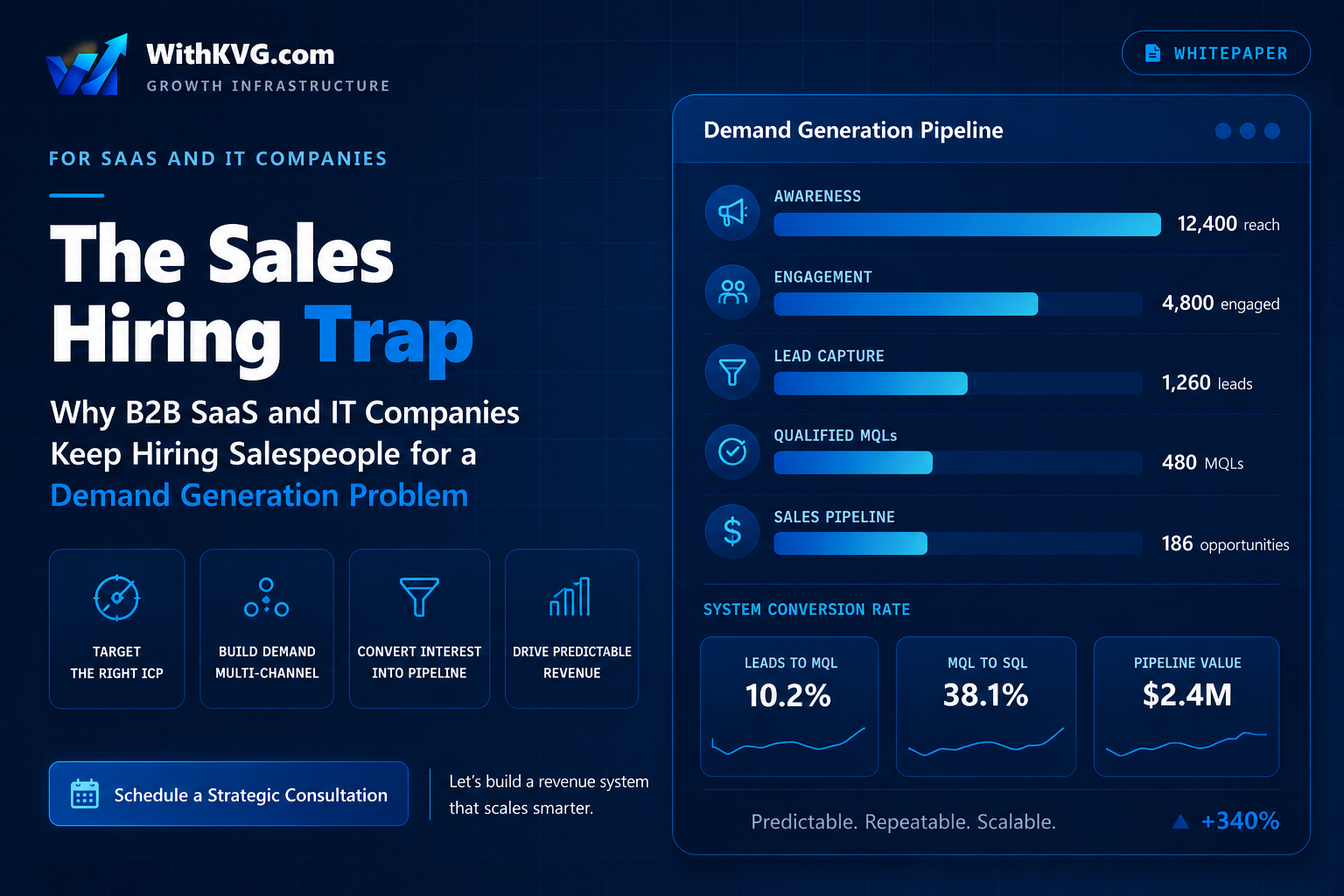
There is a pattern that repeats across most B2B SaaS and IT companies.
Marketing is active.
Sales is busy.
CRM is full.
But revenue is still inconsistent.
And internally, everything looks fine.
Until you zoom in.
That’s when the real issue appears:
Everyone is working hard, but no one is working on the same system.
Drive Real Marketing Results That Matter
We turn leads into predictable revenue for growing brands.
The Illusion of Alignment
On the surface, marketing and sales appear aligned:
- marketing generates leads
- sales follows up
- reports are shared
- dashboards are updated
But underneath, they are operating on completely different definitions of reality.
Marketing defines success as:
- leads generated
- cost per lead
- campaign performance
Sales defines success as:
- conversations booked
- deal quality
- closing probability
Finance defines success as:
- revenue
- predictability
- margins
So even though everyone is “performing,” they are not synchronized.
They are measuring different outcomes.
The Real Problem: Broken Handoff, Not Broken Performance
Most companies assume the problem is:
- poor lead quality
- weak sales execution
- low marketing performance
But in reality, the biggest failure happens in between:
the handoff between marketing and sales.
This is where revenue silently breaks.
Not in strategy.
Not in execution.
But in transition.
Where Revenue Actually Gets Lost
There are four critical breakdown points:
1. Lead Definition Gap
Marketing says a lead is:
- form fill
- download
- ad conversion
Sales says a lead is:
- qualified conversation
- budget confirmed
- decision-maker identified
So leads arrive “technically valid” but commercially weak.
2. Timing Gap
Marketing delivers leads immediately.
Sales follows up:
- too late
- inconsistently
- without context
By the time sales engages, interest is already cold.
3. Ownership Gap
No one fully owns the journey.
- marketing stops at form submission
- sales starts at first call
- nobody owns the full revenue path
So accountability disappears.
4. Feedback Gap
Sales rarely feeds structured insight back to marketing.
So marketing:
- repeats the same campaigns
- optimizes the wrong metrics
- scales noise instead of signal
Why This Is Worse in SaaS and IT Companies
In SaaS and IT services businesses:
- sales cycles are long
- multiple stakeholders are involved
- technical evaluation delays decisions
- CRM systems are overloaded with data
So small misalignment becomes amplified into:
unpredictable revenue performance
What looks like “slow growth” is often just:
system fragmentation.
The Hidden Cost: False Productivity
Both teams are busy.
But busyness hides inefficiency.
Marketing:
- optimizes campaigns
- increases lead volume
Sales:
- increases outreach
- increases follow-ups
But without alignment, all activity cancels itself out.
More effort does not equal more revenue.
It often equals more confusion.
The Real Issue: No Shared Revenue System
The core problem is simple:
Marketing and sales are not operating on a shared revenue system.
They are operating on:
- separate goals
- separate metrics
- separate tools
- separate definitions of success
So even when performance improves individually, revenue does not stabilize.
What High-Performing B2B Companies Do Differently
Companies that scale predictably do not rely on alignment meetings.
They build systems where alignment is automatic:
- unified lead qualification rules
- shared CRM structure
- real-time lead scoring
- automated follow-up flows
- revenue-based reporting (not activity-based)
- ABM targeting instead of mass lead generation
They don’t “fix alignment.”
They design it out of the system.
How WithKVG Fixes This
At WithKVG, we don’t treat marketing and sales as separate functions.
We treat them as one revenue system.
We identify where breakdown happens:
- lead quality definitions
- CRM structure issues
- delayed follow-up systems
- missing attribution layers
- weak handoff processes
Then we rebuild the structure so both teams operate on:
one shared revenue reality
This includes:
- ABM strategy alignment
- CRM and pipeline restructuring
- marketing-to-sales automation
- revenue tracking systems
- demand + conversion integration
Explore how this connects to execution:
WithKVG Solutions
See real outcomes from structured systems:
WithKVG Case Studies
The Real Insight
Most B2B companies don’t have a performance problem.
They have a coordination problem.
And until marketing and sales operate on the same revenue system:
effort will increase faster than results.
Ready to predict revenue with confidence?