Pipeline reports often look confident right up until revenue doesn’t match them.
On the surface:
- opportunities are progressing
- meetings are happening
- CRM stages are moving
But those signals don’t answer the only question that matters:
👉 Will this deal close or not?
Answering that requires a different way of looking at pipeline data entirely.
Drive Real Marketing Results That Matter
We turn leads into predictable revenue for growing brands.
Lead Generation: Capturing Existing Demand
Lead generation operates at the point where interest already exists.
It includes:
- form submissions
- demo requests
- gated content downloads
- inbound inquiries
At this stage, the buyer:
- knows the problem
- is exploring solutions
- is closer to making a decision
Lead generation is conversion-focused.
But it depends on something critical:
👉 demand already being there
Demand Generation: Creating Buying Intent
Demand generation happens earlier.
Before forms.
Before demos.
Before pipeline.
It focuses on:
- educating the market
- shaping perception
- building awareness of problems
- positioning your solution
This includes:
- strategic content
- thought leadership
- outbound messaging
- brand positioning
- market education
Demand generation is not about leads.
It’s about:
👉 making your future buyers ready to become leads
Where Most B2B SaaS & IT Companies Get It Wrong
Execution often starts here:
- run ads
- push demos
- generate leads
But if the market is not ready:
- leads are low quality
- sales cycles become longer
- conversion rates drop
What looks like a marketing issue is actually a demand problem.
Leads are being forced before intent is built.
The Real Difference (Operationally)
Lead generation asks:
👉 Who is ready now?
Demand generation asks:
👉 Who should be ready in the next 3–6 months?
One captures.
The other creates.
If you only capture, growth plateaus.
If you only create, revenue delays.
You need both – in the right structure.
Why Lead Generation Alone Fails to Scale
When companies rely only on lead generation:
- they compete for existing demand
- cost per lead increases
- differentiation disappears
- pipeline becomes inconsistent
You are fighting for buyers who are already evaluating multiple options.
Why Demand Generation Without Conversion Fails
On the other side, companies invest in content and awareness but:
- don’t connect it to pipeline
- don’t guide buyers toward action
- don’t structure conversion paths
This creates visibility – not revenue.
What a Real System Looks Like
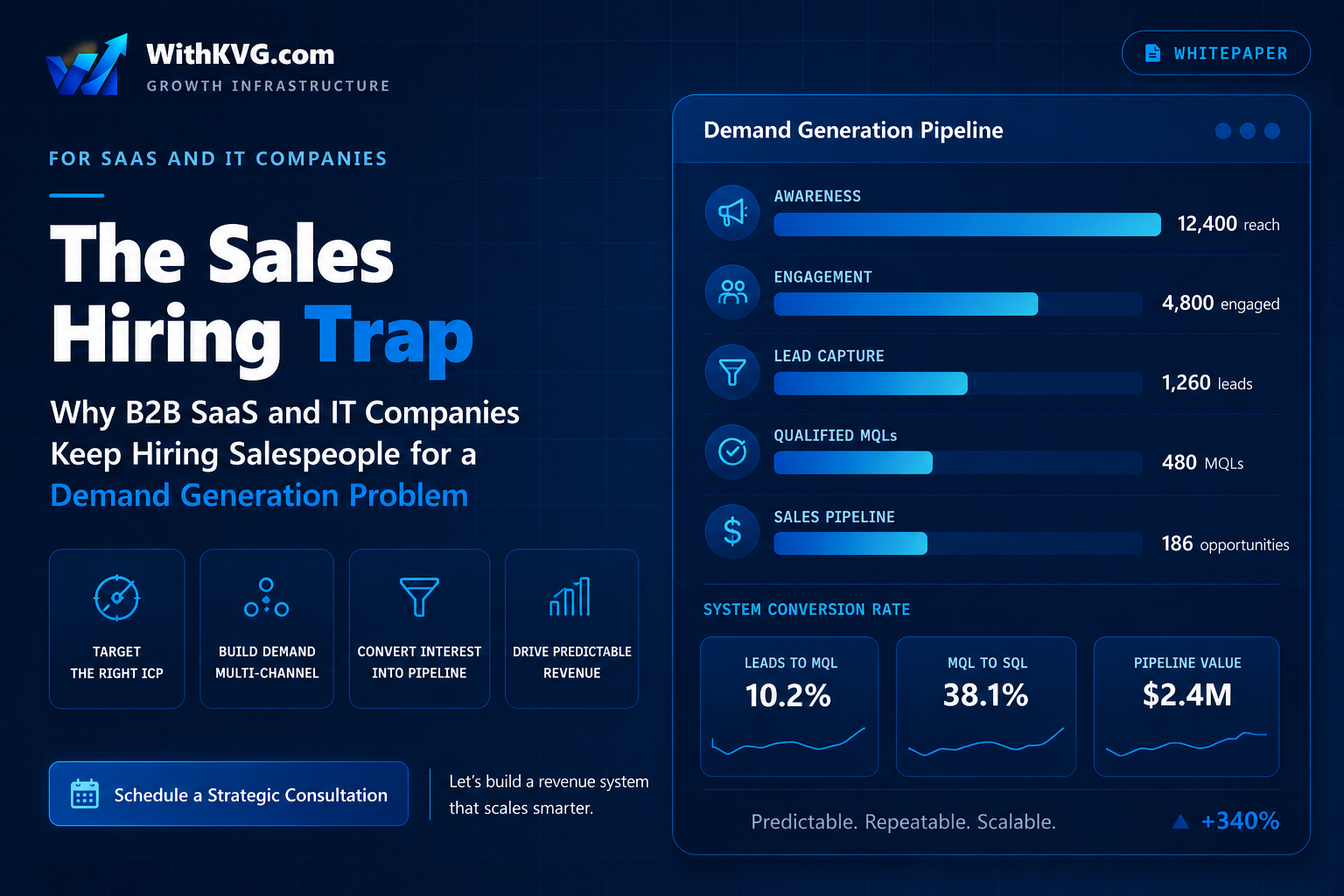
High-performing B2B SaaS and IT companies connect both into one flow:
- Demand creation
→ educate and shape the market - Demand capture
→ convert ready buyers - Demand qualification
→ filter real opportunities - Sales execution
→ move deals to revenue
Each stage feeds the next.
Nothing operates in isolation.
How WithKVG Does It
At WithKVG, we don’t treat demand generation and lead generation as separate activities.
We build a connected system designed to move buyers from awareness to revenue.
That includes:
- market positioning and messaging
to attract the right audience early - content and outbound strategy
to create demand and influence buying decisions - conversion-focused campaigns
to capture high-intent leads - qualification frameworks
to ensure only real opportunities enter the pipeline - CRM and data alignment
to track performance across the full revenue journey
The result is not more leads.
It is:
👉 better pipeline quality and predictable revenue
Ready to predict revenue with confidence?