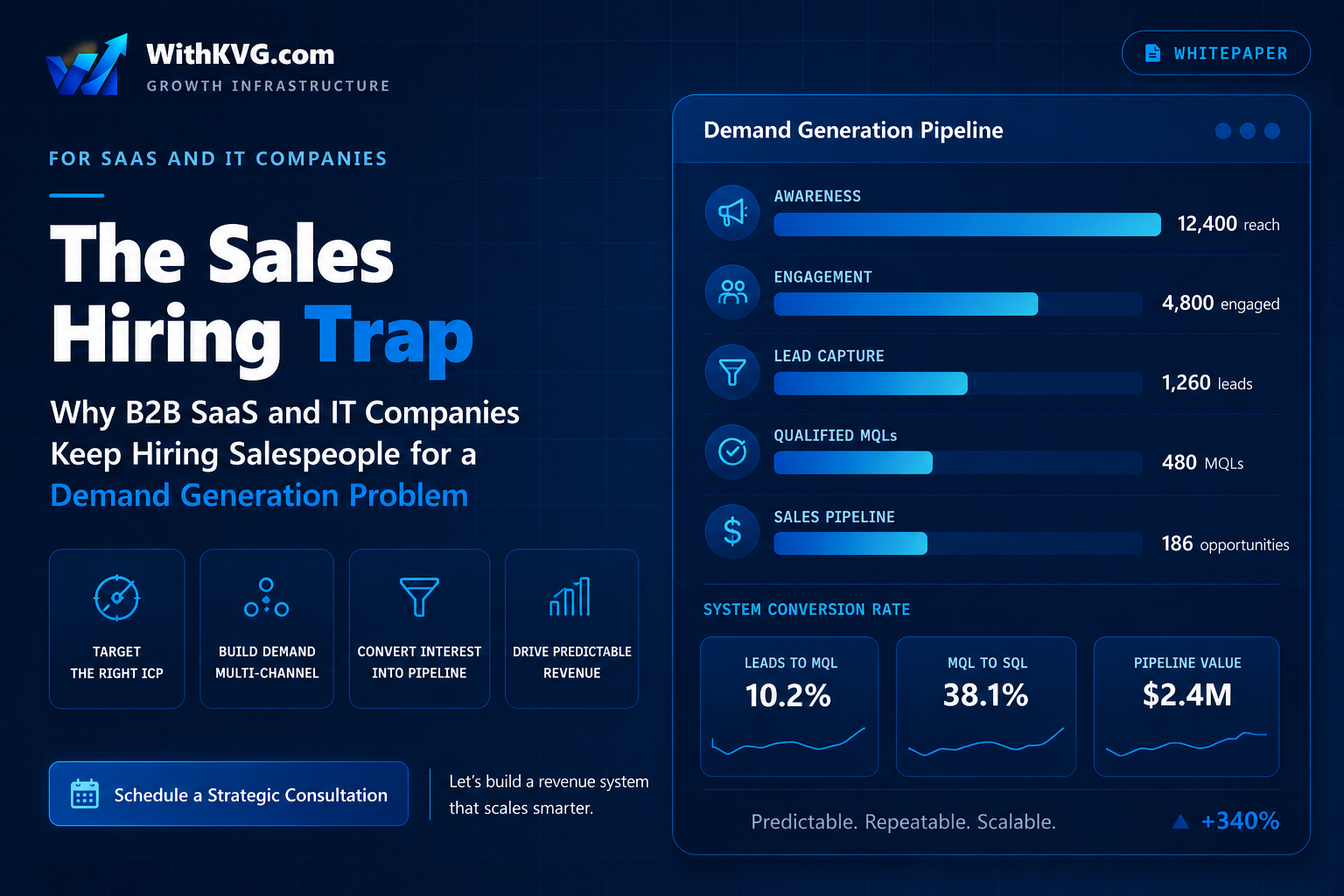
Drive Real Marketing Results That Matter
We turn leads into predictable revenue for growing brands.
The Real Problem CEOs Don’t Talk About
Most CEOs think they have a marketing performance problem.
They don’t.
They have a visibility problem.
Marketing teams send reports filled with:
- impressions
- clicks
- leads
- engagement rates
And on paper, everything looks “healthy”.
But revenue doesn’t move.
So the real question becomes:
How do you actually know if marketing is working?
Not based on activity.
Based on business impact.
Why Marketing Reports Are Misleading
Marketing reporting is designed to show progress, not truth.
Because most systems optimize for what is easy to measure:
- traffic is easy
- leads are easy
- engagement is easy
But revenue is harder.
So what happens is:
- teams report upstream metrics
- leadership assumes downstream results will follow
- but the connection is never verified
This is why companies grow “activity” but not revenue.
The Only Metric That Actually Matters
If you strip everything away, there is one truth:
Marketing only matters if it contributes to revenue.
Everything else is supporting data.
So CEOs should stop asking:
- How many leads did we get?
And start asking:
- How many leads became revenue?
- How predictable is that conversion?
- What % of pipeline is actually real?
If marketing cannot answer this clearly, it is not a performance system it is an activity system.
The 5 Revenue Signals CEOs Should Track Instead
If you want real clarity, ignore vanity dashboards and focus on these:
1. Lead-to-Revenue Conversion Rate
How many leads actually become paying customers?
If this is low, volume doesn’t matter.
2. Pipeline Quality (Not Quantity)
A full pipeline means nothing if deals are weak, delayed, or unqualified.
3. Sales Cycle Consistency
Unpredictable cycles = broken marketing targeting or misaligned messaging.
4. Revenue Attribution Clarity
Can you trace revenue back to specific campaigns or channels clearly?
If not, you’re guessing.
5. CAC Efficiency Over Time
If cost to acquire customers is rising without revenue lift, marketing is decoupled from performance.
The Hidden Break: Marketing-Sales Disconnect
Even strong marketing fails when sales is misaligned.
Typical breakdown:
- marketing optimizes for lead volume
- sales rejects leads as low quality
- leadership sees both sides blaming each other
This creates a false illusion that “marketing is underperforming”.
In reality, the system is broken between them.
What High-Performing Companies Do Differently
Top-performing B2B companies don’t rely on reports.
They build systems where:
- every lead is tracked to revenue
- sales and marketing share the same KPIs
- dashboards reflect real pipeline movement, not activity
They don’t ask:
“Is marketing working?”
They ask:
“Is the system producing revenue predictably?”
How CEOs Should Actually Evaluate Marketing
If you want a simple executive test:
- Can I predict next quarter’s revenue from marketing data alone?
- Can I see which campaigns produce closed deals?
- Can I trust the pipeline without manual validation?
- Do sales and marketing agree on what a “good lead” is?
- Does marketing activity correlate with revenue growth?
If the answer is “no” to any of these you don’t have a marketing performance system.
You have reporting noise.
The Shift That Changes Everything
Most CEOs try to improve marketing.
The real fix is different:
Fix the system that marketing is operating inside.
Because even good marketing cannot fix:
- bad data
- unclear ICP
- broken attribution
- misaligned sales processes
You don’t scale marketing.
You scale systems that make marketing measurable
How WithKVG Approaches This
At WithKVG, we don’t evaluate marketing by activity.
We evaluate it by revenue traceability.
We help companies:
- connect marketing directly to revenue outcomes
- fix CRM and attribution gaps
- align sales and marketing KPIs
- build predictable pipeline systems
Because once the system is fixed:
- marketing becomes measurable
- sales becomes predictable
- revenue becomes forecastable
Final Thought
If your marketing reports look good but revenue is unstable, the issue is not effort.
It’s interpretation.
And until you fix how marketing is measured, you will always confuse activity with performance.
Ready to predict revenue with confidence?