
















Why SaaS and IT Companies in Jordan, UAE, and Saudi Fail to Turn Demand Into Closed Revenue
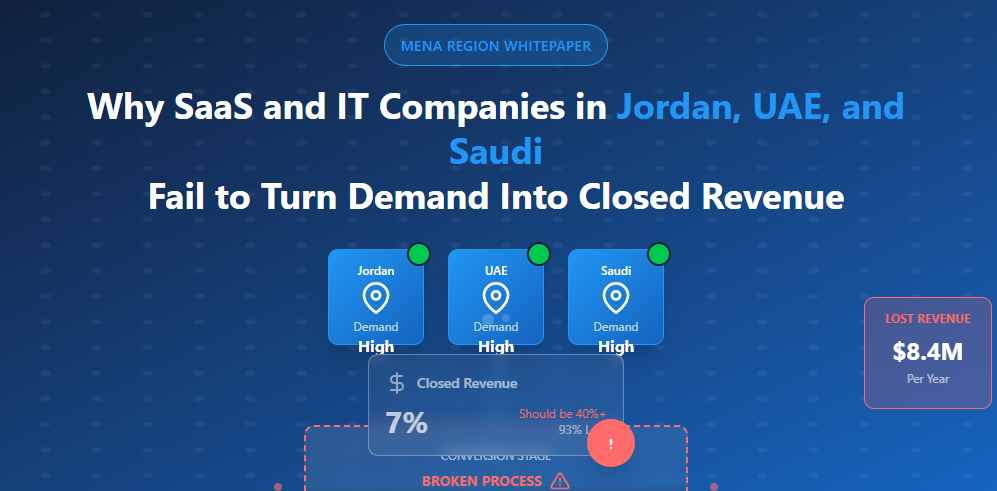
Table of Contents:
Introduction: The Real Reason Revenue Is Not Predictable in SaaS and IT Companies
Across Jordan, UAE, and Saudi Arabia, SaaS companies, IT service providers, and digital solution firms are experiencing a similar pattern:
They are generating leads consistently, investing in marketing campaigns, and expanding sales activity yet revenue remains unstable.
This is not a demand problem.
It is a revenue execution problem.
Most companies believe growth is determined by how many leads they generate. In reality, growth is determined by how effectively those leads are converted into revenue through structured execution systems.
Explore how we structure this approach through our Strategy & Growth Foundation.
Why Demand Generation Is Not Enough Anymore in Jordan, UAE, and Saudi
Demand generation in B2B SaaS and IT markets has become more accessible than ever:
- Paid advertising platforms are saturated
- LinkedIn outreach is widely adopted
- Automation tools are widely available
- Content production is commoditized
This means demand is no longer the competitive advantage.
Execution is.
Companies in Jordan, UAE, and Saudi are often competing with similar tools, similar strategies, and similar channels yet achieving very different revenue outcomes.
Read more about demand vs revenue confusion in our article on lead generation vs demand generation.
The Illusion of Pipeline Growth Without Revenue Growth
One of the most dangerous patterns in SaaS and IT companies is pipeline inflation.
CRM dashboards show increasing:
- opportunities
- leads
- meetings
- deals in progress
But revenue does not follow the same trajectory.
This happens because pipeline metrics reflect activity, not execution quality.
Learn more in why marketing KPIs often mislead leadership teams.
Where Revenue Actually Breaks in B2B SaaS and IT Systems
Revenue loss does not happen at one point. It happens across multiple execution layers:
- lead response delay after capture
- inconsistent qualification processes
- weak sales follow-up discipline
- misaligned marketing and sales handoff
- CRM systems that do not reflect real buyer behavior
These breakdowns are structural, not tactical.
Explore execution systems in our automation and CRM optimization solutions.
The First 48 Hours of Lead Response and Why Timing Defines Revenue
In SaaS and IT sales cycles, the first 48 hours determine whether revenue is captured or lost.
During this period:
- buyer intent is at its peak
- competitor engagement is active
- response expectations are immediate
Delays or inconsistent responses reduce conversion probability significantly.
Read more in why speed to lead drives revenue outcomes.
Speed to Lead and Its Impact on Conversion Rates
Speed to lead is one of the most under-optimized factors in B2B revenue systems.
In Jordan, UAE, and Saudi markets, response time often determines:
- meeting conversion rates
- deal progression speed
- competitive advantage in sales cycles
Companies with faster response systems consistently outperform companies with higher marketing budgets.
The Follow-Up System Breakdown in B2B Sales
Most SaaS and IT companies do not lose deals in initial conversations.
They lose them in follow-up execution.
Common failures include:
- no structured follow-up sequences
- inconsistent outreach timing
- lack of ownership clarity
- no tracking of engagement decay
This creates silent revenue leakage across the funnel.
Learn more in how to nurture leads after outreach.
Why CRM Systems in SaaS Companies Do Not Reflect Real Revenue Health
CRM systems are widely used across SaaS and IT companies in the region, but they often fail to reflect reality.
They track:
- pipeline stages
- activity logs
- forecasted revenue
But they fail to track:
- response latency
- follow-up consistency
- conversion probability
- execution discipline across teams
This creates a false sense of growth.
Marketing and Sales Misalignment in B2B Organizations
One of the most persistent issues in SaaS and IT companies is misalignment between marketing and sales.
Marketing focuses on lead volume.
Sales focuses on conversion quality.
Without structured alignment, leads are generated without being effectively converted.
Read more in why marketing and sales misalignment kills revenue.
Why More Leads Do Not Solve Growth Problems
Increasing lead volume without fixing execution systems leads to:
- higher acquisition costs
- lower conversion rates
- increased sales inefficiency
This is why many companies scale activity but not revenue.
Why SaaS Companies Fail to Scale Even with Strong Demand
Even when demand is strong, scaling fails due to:
- inconsistent execution systems
- lack of operational revenue structure
- weak CRM alignment
- poor follow-up discipline
Explore this further in why most SaaS companies cannot scale even with more leads.
The Role of Revenue Operations in Fixing Execution Gaps
Revenue Operations (RevOps) is becoming critical for SaaS and IT companies in Jordan, UAE, and Saudi.
It focuses on aligning:
- marketing execution
- sales execution
- CRM systems
- revenue tracking
This alignment is what converts activity into predictable revenue.
What a Revenue Execution System Looks Like in High-Performing Companies
A high-performing revenue execution system includes:
- defined response time standards
- structured follow-up workflows
- CRM systems aligned with real behavior
- clear ownership at every stage
- continuous performance visibility
Without this structure, revenue remains inconsistent regardless of demand.
How WithKVG Builds Predictable Revenue Systems for SaaS and IT Companies
WithKVG designs and implements revenue execution systems for companies across Jordan, UAE, and Saudi Arabia.
We focus on:
- revenue system architecture
- CRM optimization and automation
- marketing and sales alignment
- lead conversion system design
- execution workflow optimization
Explore our Software as a Service swimlane and IT Services swimlane.
Case Studies Across SaaS, IT Services, and Digital Transformation Companies
See how execution systems are implemented in real companies:
https://withkvg.com/case-studies/
Including:
- SaaS platforms
- IT service providers
- digital transformation companies
Conclusion and Strategic Next Steps
Revenue instability is not a marketing problem.
It is an execution system problem.
Companies that fix execution between marketing, sales, and CRM systems move from unpredictable growth to structured revenue performance.
Schedule a Strategic Consultation