















Why High Client Retention Is Reducing Profit Margins and Increasing Service Costs
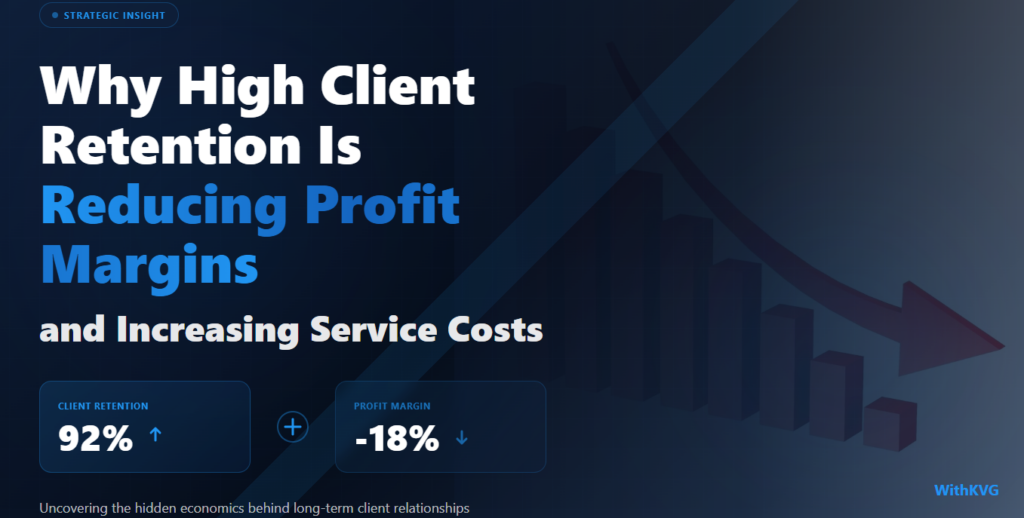
Table of Contents:
Retention Paradox
Most leadership teams treat retention as a pure success metric.
But high retention without structural efficiency creates a silent margin leak:
- revenue stays stable
- operational effort compounds
- cost per client increases over time
This is why companies appear stable while quietly becoming less profitable.
The real issue is not retention itself, but how it is structurally managed inside a business system.
Learn more about how we design connected business systems at
WithKVG’s strategy and growth foundation
Why Retention Is Not the Problem
Retention is not the issue.
Inefficient retention is.
Companies confuse “keeping clients” with “profitable client management.”
But not all retained clients should be treated equally:
- some should scale
- some should be optimized
- some should be exited
Without segmentation, retention becomes emotional instead of economic.
See how we approach structured growth systems:
Solutions
Hidden Cost Drivers Inside Existing Clients
The biggest margin erosion happens inside existing accounts—not new acquisition.
Typical hidden cost drivers include:
- scope expansion without repricing
- custom requests becoming standard delivery
- manual support replacing scalable systems
- lack of boundaries in account management
Over time, clients become operationally heavier without increasing revenue proportionally.
See real-world execution examples in
WithKVG case studies and implementations
Why Service Costs Increase Without New Sales
Even with no new clients, costs rise because internal effort compounds.
This happens due to:
- increasing dependency on internal knowledge per client
- growing expectation of faster response cycles
- legacy system complexity accumulating over time
Each retained client gradually requires more effort to maintain the same output level.
This is why companies feel “busy” without feeling growth.
Operational Efficiency Breakdown
Inefficiency is usually not visible in one place—it is distributed across the system:
- delivery becomes more customized and less repeatable
- account management replaces structured lifecycle design
- marketing and delivery operate in isolation
When systems are not aligned, efficiency collapses silently even if revenue remains stable.
Understand how operational systems are structured at
Swimlane-based business architecture
How Companies Fall Into the Client Loop Trap
The “client loop trap” forms gradually:
- long-term clients are seen as inherently positive
- retention becomes the primary success metric
- pricing does not evolve with delivery complexity
- operational effort is absorbed instead of controlled
Eventually, companies end up optimizing for relationship maintenance instead of profitability.
Breaking the Loop With Revenue Efficiency Systems
The solution is not reducing retention.
It is redesigning how retention behaves economically.
Key shifts include:
- introducing cost-to-serve segmentation per client
- aligning pricing with operational effort curves
- embedding expansion logic into every client lifecycle
- removing manual dependency from service delivery
Retention must be measured by profitability, not duration.
See how this is implemented through automation and optimization systems at
Revenue automation and CRM optimization
How WithKVG Fixes This Structure
At WithKVG, this is treated as a revenue architecture problem—not a marketing issue.
We restructure three layers:
- Strategy layer: defining profitable client structures
Growth strategy and market positioning - Demand layer: ensuring acquisition matches delivery capacity
Demand generation and digital marketing systems - Execution layer: reducing manual effort per retained client
Automation and CRM optimization systems
The goal is not more clients- it is more efficient clients.
Case Study Proof
This is not conceptual.
Across multiple industries, the same pattern appears:
- Softrax transformation case study
- Blulogix operational alignment case study
- TopNotch Technology efficiency improvement
- Storyjo revenue system optimization
The outcome is consistent:
When client systems are redesigned, profitability improves even without increasing acquisition.
The New Retention Model
Retention should no longer be treated as a success metric.
It should be treated as a managed economic system.
Modern organizations must shift from:
- retaining all clients
to - retaining only profitable, scalable, and system-aligned clients
This is how margin is protected while maintaining stability.
Frequently Asked Questions
No. High retention is only problematic when it is not aligned with profitability. If the cost to serve a client increases faster than the revenue it generates, retention becomes a margin drain instead of a growth asset.
Because retention is treated as a success KPI. Leadership focuses on churn reduction, not cost-to-serve efficiency. This hides the fact that some retained clients are actually unprofitable.