














Why AI Products Fail to Gain Market Adoption and How to Build a Revenue Engine That Enterprise Buyers Trust
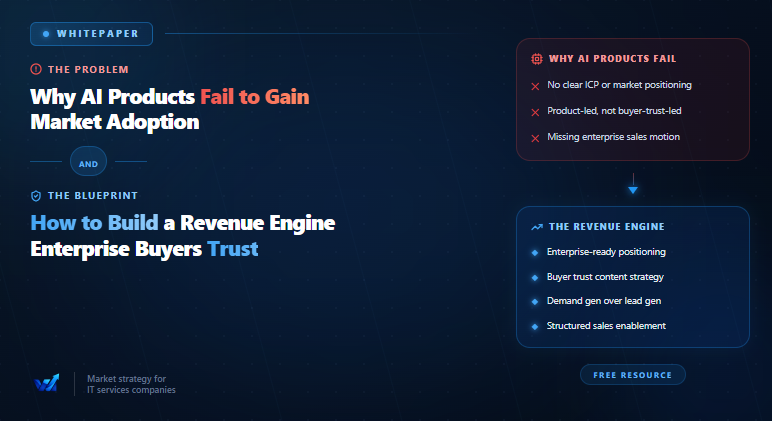
Table of Contents:
An AI product can achieve outstanding accuracy, powerful automation, and advanced capabilities, yet still fail to generate consistent enterprise sales if its value isn’t communicated in business terms.
This whitepaper explains why many AI products fail to gain market traction and outlines the core elements required to build a predictable revenue engine.
Introduction
Launching an AI product is only the beginning.
Enterprise buyers rarely purchase technology because it is innovative.
They invest because it solves measurable business problems, reduces operational risk, improves efficiency, or creates financial value.
Without a structured go-to-market strategy, even exceptional AI products struggle to build momentum.
Why Great AI Products Still Fail
Most AI companies focus heavily on product development but invest too little in market positioning.
Common challenges include:
- Messaging focused on technology instead of business outcomes.
- An unclear ideal customer profile.
- Weak differentiation from competitors.
- No predictable demand generation process.
- Sales that depend entirely on the founder.
Technology creates interest.
Positioning creates demand.
The Four Growth Challenges AI Companies Face
Positioning
If buyers cannot immediately understand the business value, they will not continue the conversation.
Trust
Enterprise organizations expect proof before they invest.
Case studies, industry expertise, and thought leadership are essential.
Demand Generation
A great product still needs a consistent system that attracts qualified decision makers.
Revenue Visibility
Marketing, sales, and CRM should operate as one connected revenue engine instead of separate activities.
What Enterprise Buyers Actually Want
Enterprise buyers rarely ask:
“What AI model do you use?”
Instead, they ask:
- How will this reduce costs?
- How much time will this save?
- How quickly can we implement it?
- What business results should we expect?
- Can we trust your company?
Successful AI marketing answers these questions before the first sales meeting.
Building a Revenue Engine for AI Products
A predictable growth system combines:
- Clear market positioning.
- Ideal customer profile definition.
- Business-focused messaging.
- Thought leadership and educational content.
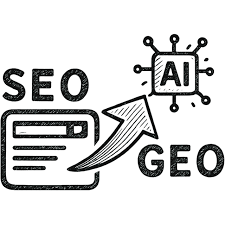
- SEO, GEO, and AI search optimization.
- LinkedIn authority.
- Account-Based Marketing.
- CRM automation and pipeline management.
- Performance measurement tied to revenue.
These components work together to generate consistent opportunities instead of relying on referrals or isolated campaigns.
How WithKVG Helps AI Companies Grow
At WithKVG, we don’t simply promote AI products.
We build revenue systems that help AI companies earn trust, generate demand, and create predictable sales opportunities.
Our approach includes:
- AI product positioning and messaging.
- Demand generation strategy.
- Executive LinkedIn thought leadership.
- SEO, GEO, and Answer Engine Optimization.
- Website optimization for enterprise buyers.
- CRM and revenue automation.
- Account-Based Marketing campaigns.
- Sales enablement and pipeline optimization.
The objective is straightforward:
Turn technical innovation into measurable business growth.
Conclusion
The companies that win in the AI market are not always those with the most advanced technology.
They are the companies that communicate value clearly, build trust consistently, and operate a repeatable revenue system.
Technology creates possibility.
A structured growth engine creates predictable revenue.