








If Your Partners Stop Sending Leads Tomorrow, What Happens Next?
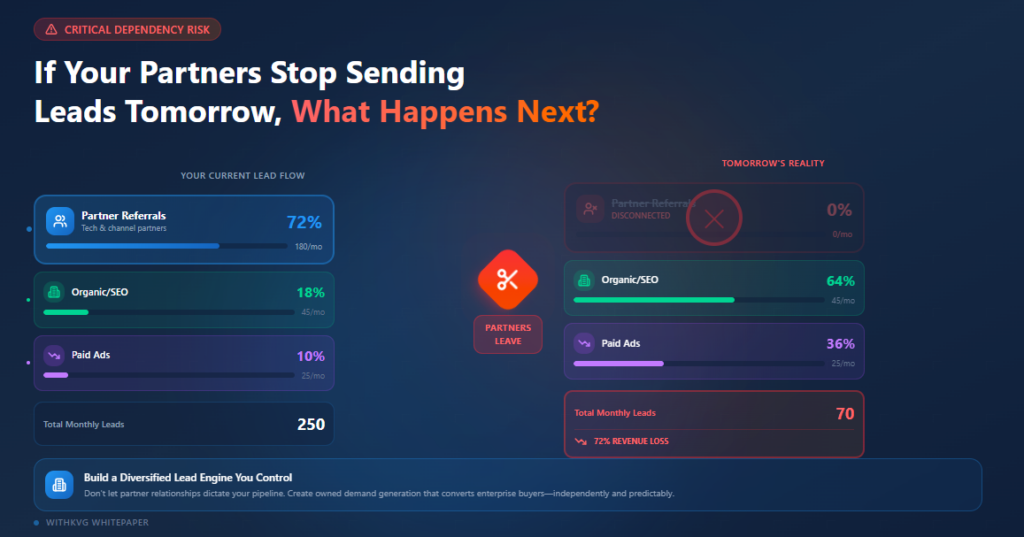
Table of Contents:
Executive Summary
Most companies believe their growth is stable because their pipeline is active.
Deals are coming in. Partners are sending opportunities. Revenue is moving.
But this creates a dangerous illusion.
Your growth is not owned. It is dependent.
The moment external sources slow down, your pipeline becomes unpredictable and your revenue follows.
This whitepaper explores why relying on partnerships, referrals, and external channels is a short term growth model and how companies can transition into predictable, scalable revenue systems.
For a deeper breakdown, read
👉 Why your pipeline does not translate into revenue
The Illusion of Stability
Partnership driven growth feels safe.
You have consistent deal flow. You trust your network. Revenue appears stable.
But this is not stability. It is borrowed momentum.
You are not generating demand. You are receiving it.
That means you do not control your pipeline.
Many companies only realize this when performance drops.
To understand this risk better, read
👉 Why relying only on referrals will break your company
The Hidden Dependency Problem
When your growth depends on partnerships, you lose control over volume, timing, and quality.
Your pipeline becomes dependent on external decisions.
One partner shifts priorities and your pipeline drops.
Adding more partners does not solve this. It spreads the risk instead of eliminating it.
Real growth comes from ownership, not dependency.
The Breaking Point When Growth Slows Down
Every company reaches a stage where partnership driven growth stops working.
You start seeing declining lead quality, inconsistent deal flow, and longer sales cycles.
At this point, most companies push harder instead of fixing the system.
More outreach. More campaigns. More effort.
But without alignment between sales and marketing, nothing improves.
To see how this misalignment impacts revenue, read
👉 Why marketing and sales do not align and how it kills revenue
The Real Cost of Waiting
Delaying this shift has real consequences.
Customer acquisition cost increases. Conversion rates drop. Revenue becomes unstable.
Most companies are already losing money but do not see the root cause.
To understand the financial impact, read
👉 Why marketing spend fails to generate ROI
The Shift From Partner Dependency to Revenue Ownership
Sustainable growth requires moving from external dependency to internal control.
This means building a system that creates demand, captures it, and converts it into revenue.
Companies that do this gain predictable pipeline and higher quality opportunities.
To start building this foundation, explore
👉 Strategy and growth foundation
The Revenue Architecture Framework
Growth is not driven by isolated tactics. It is built through a structured system.
7.1 Defining a High Conversion ICP
Targeting the right customers is the foundation of everything.
👉 Growth strategy and market positioning
7.2 Creating Demand Instead of Waiting for It
You need to generate interest before buyers are actively searching.
👉 Demand generation and digital marketing
7.3 Building a High Intent Capture System
Turning attention into qualified opportunities is critical.
👉 Website SEO and conversion optimization
7.4 Fixing the Conversion Layer
This is where revenue is actually won or lost.
👉 CRM and revenue optimization
7.5 Continuous Optimization and Visibility
You need to track what actually drives revenue.
Self Diagnosis How Dependent Is Your Business
Ask yourself:
What percentage of your pipeline comes from partners
Can your marketing generate opportunities independently
Do you control your demand sources
If the answers are unclear, your growth is dependent.
Run a deeper audit here
👉 Revenue leak audit
Real World Scenarios Where Companies Lose Control
Common patterns include over reliance on a few partners, high pipeline with low revenue, and marketing without results.
These are structural issues, not execution problems.
See real examples
👉 Case studies
How to Start Taking Back Control
The first step is fixing your foundation.
Define your ICP. Align sales and marketing. Build demand. Improve conversion.
For a practical starting point, read
👉 How to build a marketing strategy that generates leads
How WithKVG Helps
At WithKVG, we help companies move from unpredictable growth to structured revenue systems.
We connect strategy, demand generation, conversion, and optimization into one unified approach.
Learn more about
👉 WithKVG
Explore full capabilities
👉 Solutions
Conclusion Growth You Do Not Control Is Growth You Can Lose
Partnerships can support growth but they should never be the foundation.
If your business cannot generate demand independently, it is vulnerable.
The companies that win are the ones that control their pipeline.
Next Step Revenue System Diagnosis
If you want to understand exactly where your growth is breaking
This will help you identify pipeline gaps, conversion issues, and demand generation weaknesses.