
















How B2B SaaS Companies Avoid Letting Their Biggest Customer Control Product Strategy and GTM
This whitepaper explains how B2B SaaS leaders can distinguish valuable customer feedback from genuine market signals before changing the product, ICP, positioning, or go to market strategy.
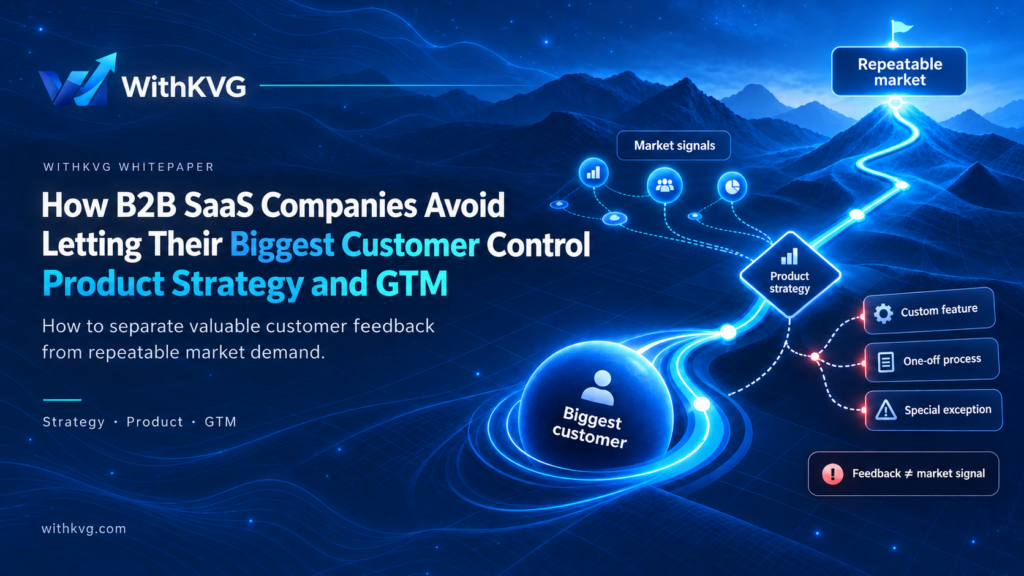
Table of Contents:
When Customer Feedback Starts Driving the Roadmap
Listening to customers is important.
But problems begin when one customer’s requests start determining:
- Product priorities
- Development resources
- Positioning
- Sales messaging
- Target markets
- Future integrations
The company may believe it is becoming more customer centric.
In reality, it may be becoming customer dependent.
The question is not:
Should we listen to the customer?
The question is:
Does this request represent the market we want to build for?
Customer Feedback vs. Market Signal
These are not the same thing.
Customer Feedback
Tells you what one customer wants, experiences, or struggles with.
Market Signal
Shows that a problem exists repeatedly across the market you are intentionally targeting.
A request becomes more strategically meaningful when:
- Multiple customers mention the same problem.
- Prospects raise it during sales conversations.
- Lost deals reference the same gap.
- Search behavior shows demand.
- Competitors are addressing the same use case.
- The request aligns with your ICP.
- The capability can be sold repeatedly.
One customer asking loudly is data. It is not automatically demand.
The Hidden Cost of Building for Your Biggest Customer
The direct development cost is only part of the risk.
A custom feature can also create:
- Product complexity
- Additional maintenance
- Support requirements
- Technical debt
- Longer onboarding
- Confusing positioning
- Sales expectations
- New implementation requirements
And there is a bigger strategic risk.
Your product can slowly become excellent for one customer while becoming less relevant to the market you originally wanted to own.
The Market Signal Test
Before changing the roadmap, ask six questions.
| Question | What You Are Testing |
|---|---|
| Who is asking? | Is this customer part of our priority ICP? |
| How many are asking? | Is the problem repeated? |
| Why do they need it? | Is there a deeper business problem? |
| Can we sell it again? | Is the capability repeatable? |
| Does it strengthen our position? | Does it support where we want the product to go? |
| Will buyers pay for it? | Is there commercial demand behind the request? |
The strongest requests normally sit at the intersection of:
- Customer Need
- ICP Relevance
- Repeatability
- Commercial Value
- Strategic Fit
That is much closer to a market signal.
How Customer Requests Can Pull You Away From Your ICP
This is where the issue becomes a GTM problem.
Imagine your product was built for:
Mid market logistics companies
Your largest enterprise customer starts requesting:
- Complex approval workflows
- Custom reporting
- Unique integrations
- Bespoke permissions
- Special implementation requirements
Those features may be valuable to that customer.
But if your intended market does not need them, you may gradually change:
- The product
- The sales cycle
- The buyer
- The implementation model
- The pricing
- The support model
Eventually, you are no longer selling the business you originally designed.
Roadmap drift can become ICP drift.
When a Feature Request Should Influence Product Strategy
A request deserves stronger consideration when it:
- Appears across multiple ICP accounts.
- Solves an important business problem.
- Helps win or retain similar customers.
- Strengthens the core product.
- Creates a repeatable capability.
- Supports the company’s strategic direction.
- Creates measurable commercial value.
A request deserves more caution when it:
- Comes from only one account.
- Requires heavy customization.
- Benefits an edge case.
- Pulls the company toward a different market.
- Creates significant maintenance.
- Cannot easily be sold again.
The decision should never be based only on:
“This is our biggest customer.”
How Product, Marketing and Sales Should Validate Demand Together
Product should not validate demand alone.
Neither should sales.
Neither should marketing.
Each team sees a different part of the market.
Sales sees:
- Prospect objections
- Buying requirements
- Lost-deal reasons
- Competitive pressure
Marketing sees:
- Search demand
- Content engagement
- Market conversations
- ICP patterns
- Category questions
Customer Success sees:
- Customer friction
- Product usage
- Recurring requests
- Adoption problems
Product sees:
- Usage behavior
- Technical feasibility
- Product patterns
- Roadmap implications
When the same signal appears across these areas, confidence increases.
That is market intelligence.
How WithKVG Connects Market Demand to GTM Strategy
This is where the whitepaper becomes commercially relevant for WithKVG.
We help B2B companies connect what the market is saying with:
- ICP strategy
- Positioning
- Market segmentation
- Demand generation
- Search behavior
- Content
- ABM
- Outbound
- CRM data
- Sales conversations
- Lost-deal intelligence
The objective is not to tell the product team what feature to build.
It is to help leadership understand:
Is this an isolated customer request, or is the market telling us something important?
That distinction affects much more than the roadmap.
It affects the entire GTM strategy.
Frequently Asked Questions
Look for evidence across multiple sources:
- Similar requests from ICP customers
- Questions from prospects
- Lost-deal reasons
- Search demand
- Sales conversations
- Competitive activity
- Willingness to pay
- Repeatable use cases
The stronger the pattern, the stronger the market signal.