















Why SaaS and IT Companies Need Every Core Revenue Function Working Together
Demand generation is not LinkedIn, SEO, outbound, content, or CRM working alone.
It is a connected system where every activity supports a different stage of the buyer journey and helps turn market visibility into qualified pipeline and revenue.
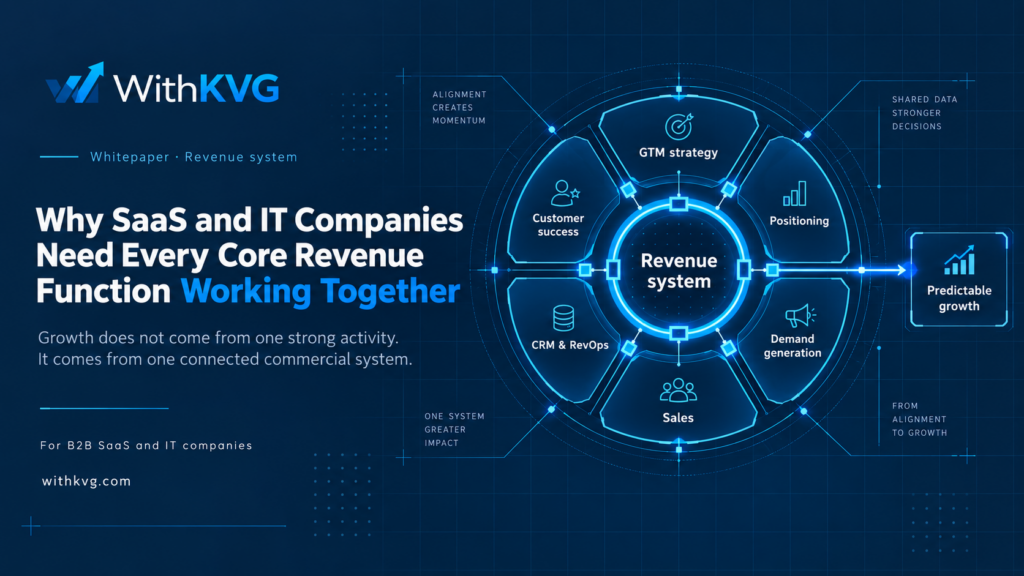
Table of Contents:
Demand Generation Is a System, Not a Channel
Companies often ask:
Which channel should we focus on?
But predictable demand rarely comes from one channel.
A complete system needs to:
- Reach the right market.
- Build awareness.
- Create trust.
- Capture active demand.
- Create demand where none exists yet.
- Convert interest.
- Nurture buyers.
- Help sales progress opportunities.
- Measure what produces revenue.
Key Point:
You do not need every tactic.
You do need every important commercial function covered.
Every Activity Has a Different Job
Each activity exists for a reason.
ICP and Positioning
Helps determine:
- Who to target.
- Which problems matter.
- Why buyers should care.
- How the company should be positioned.
Content
Helps:
- Educate buyers.
- Build expertise.
- Answer questions.
- Support sales conversations.
Helps:
- Build executive visibility.
- Reach decision makers.
- Create familiarity.
- Strengthen company credibility.
SEO, GEO and AEO
Help buyers discover the company through:
- Google.
- AI search.
- Answer engines.
- Research before contacting sales.
ABM and Outbound
Help:
- Reach priority accounts.
- Create direct conversations.
- Engage buying committees.
- Generate opportunities proactively.
Website
Turns interest into:
- Product discovery.
- Service exploration.
- Demo requests.
- Consultations.
CRM and Nurturing
Keep relationships moving when buyers are not ready immediately.
Sales Enablement
Gives sales:
- Case studies.
- Whitepapers.
- Business cases.
- Proof.
- Follow-up material.
Analytics
Shows what is actually influencing pipeline and revenue.
What Happens When One Core Function Is Missing
The system becomes weaker when critical functions disappear.
Remove Content
You weaken:
- SEO.
- GEO and AEO.
- LinkedIn.
- Sales enablement.
- Buyer education.
Remove Outbound
You become dependent on buyers finding you first.
Remove SEO
You miss buyers who are already searching for the problem you solve.
Remove LinkedIn
You reduce executive visibility and human trust.
Remove CRM Nurturing
Prospects who are not ready today often disappear.
Remove Sales Enablement
Sales must create proof and follow-up material from scratch.
Remove Analytics
You cannot confidently determine:
- What works.
- What should stop.
- What deserves more budget.
The Complete B2B Demand Generation System
A strong system connects the full buyer journey.
| Function | Purpose |
|---|---|
| ICP | Reach the right companies |
| Positioning | Give buyers a reason to care |
| Content | Educate and build authority |
| Build familiarity and executive trust | |
| SEO | Capture active search demand |
| GEO / AEO | Increase AI and answer-engine visibility |
| ABM | Focus on priority accounts |
| Outbound | Create direct conversations |
| Website | Convert interest |
| CRM | Track and nurture buyers |
| Sales Enablement | Help opportunities progress |
| Analytics | Connect activity to revenue |
The system should work like this:
ICP
↓
Positioning
↓
Visibility
↓
Trust
↓
Engagement
↓
Qualified Conversation
↓
Opportunity
↓
Revenue
Why Marketing and Sales Must Work Together
Marketing should not stop when a meeting is booked.
Sales should not start from zero.
Marketing should help sales with:
- Account intelligence.
- Buyer education.
- Case studies.
- Industry content.
- Executive visibility.
- Follow-up material.
Sales should give marketing:
- Objections.
- Lost-deal reasons.
- Buyer questions.
- Market feedback.
- Account priorities.
Together they create one revenue journey.
Marketing creates context.
Sales converts that context into revenue.
How the Activities Strengthen Each Other
One activity often improves several others.
Example
A CEO publishes a strong LinkedIn post.
A prospect:
- Sees the post.
- Searches the company.
- Visits the website.
- Reads a whitepaper.
- Checks customer proof.
- Receives an outbound message later.
- Enters CRM.
- Gets nurtured.
- Books a meeting.
Which activity created the opportunity?
Not one.
The system did.
This is why attribution should look at the whole buyer journey, not only the final click.
Prioritize the Mix Without Breaking the System
Not every company needs the same channel mix.
A Saudi enterprise-focused company may prioritize:
- ABM.
- Executive LinkedIn.
- Arabic and English content.
- Strategic outbound.
- Buyer committee mapping.
- Sales enablement.
A Jordanian SaaS or IT company may need stronger:
- Search visibility.
- Market authority.
- Outbound.
- CRM nurturing.
- Expansion into GCC accounts.
The allocation changes.
The core functions do not.
Before removing an activity, ask:
- What buyer stage does it support?
- What other activities depend on it?
- What will replace its function?
- Can we measure its contribution?
- Are we removing the channel or removing the capability?
That last question matters.
You can replace a channel.
You should not leave a critical part of the revenue journey uncovered
Outbound and ABM Need Different Commercial Motions
Another common mistake is sending one outbound sequence for the entire portfolio.
A message such as:
“We provide software solutions, cloud, cybersecurity, ERP, consulting and custom development. Would you like to meet?”
gives the buyer too much information and too little relevance.
Product Outbound
Product outreach should usually follow:
Problem
↓
Use Case
↓
Product Relevance
↓
Proof
↓
Demo
Example Structure
We are speaking with logistics companies struggling to understand fleet utilization across multiple locations.
Our platform gives operations teams one view of vehicles, utilization, maintenance and performance.
Would it be useful to show you how this works?
The product is connected to a repeatable problem.
Service Outbound
Service outreach should usually follow:
Business Problem
↓
Expertise
↓
Insight
↓
Credibility
↓
Consultation
Example Structure
We are seeing companies struggle with cloud migration because the infrastructure is moved before application dependencies and business continuity are fully mapped.
We help IT teams structure that migration before execution.
Happy to compare notes if this is currently on your roadmap.
The sale begins with expertise.
Account Based Marketing Also Changes
For a product motion, ABM may focus on:
- Product use case
- Feature relevance
- Technology fit
- Demo engagement
- Adoption potential
For a service motion, ABM may focus on:
- Business problem
- Organizational change
- Strategic initiative
- Expertise
- Project complexity
- Risk reduction
The account can be the same.
The commercial story is different.
How WithKVG Builds Demand Generation Systems
WithKVG does not treat marketing activities as isolated services.
We connect them around the revenue journey.
Strategy
- ICP.
- Market prioritization.
- Positioning.
- Messaging.
- Buying committees.
Visibility
- LinkedIn.
- Executive thought leadership.
- SEO.
- GEO.
- AEO.
- Content.
Demand Creation
- ABM.
- Outbound.
- Email.
- Campaigns.
- Target-account engagement.
Conversion
- Website.
- Landing pages.
- CTAs.
- Buyer journeys.
Nurturing
- CRM.
- Automation.
- Email sequences.
- Account follow-up.
Sales Enablement
- Case studies.
- Whitepapers.
- Business cases.
- Sales content.
- Follow-up assets.
Measurement
- Account engagement.
- Qualified meetings.
- Pipeline.
- Opportunity progression.
- Revenue attribution.
The objective is not to do more marketing.
It is to make every important part of the revenue system work together.
Conclusion
Demand generation is not about choosing between:
LinkedIn or SEO.
Inbound or outbound.
Marketing or sales.
These activities solve different problems.
A predictable revenue system needs to:
- Find the right buyers.
- Become visible.
- Build trust.
- Create demand.
- Convert interest.
- Nurture timing.
- Support sales.
- Measure revenue.
The right question is not:
“Which activity can we remove?”
It is:
“If we remove it, who will perform the job it was doing?”
That is how demand generation should be managed.