
















The Revenue System Audit Framework for SaaS and IT CEOs
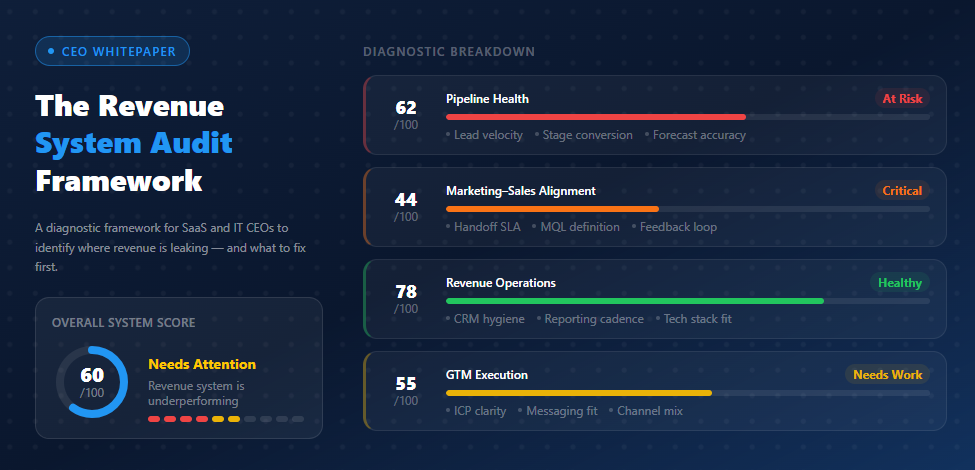
Table of Contents:
Introduction Why Growth Feels Unpredictable Even With Marketing Investment
Many SaaS and IT companies invest heavily in marketing activities.
They run campaigns, generate leads, increase traffic, and build visibility.
Yet growth remains unpredictable.
Revenue fluctuates, deals stall, and forecasting becomes unreliable.
The issue is not lack of marketing.
The issue is lack of a structured revenue system.
The Real Problem Most SaaS and IT Companies Do Not See
Most companies assume the problem is awareness or lead volume.
But in reality, the real problem is:
marketing, sales, and data are not operating as one system.
This creates fragmentation across the entire revenue lifecycle.
The Four Layers of a Revenue System Every Company Depends On
Every SaaS and IT company depends on four connected layers:
1. ICP Layer
Are you targeting the right companies with real buying intent?
2. Demand Layer
Are you creating predictable interest or relying on random leads?
3. Conversion Layer
Do qualified leads consistently turn into sales opportunities?
4. Revenue Layer
Can you trace every deal back to a source and understand what drives growth?
If any layer is weak, revenue becomes unstable.
How Revenue Leakage Actually Happens Inside B2B Organizations
Revenue leakage is rarely visible.
It happens when:
- leads are not followed up correctly
- qualification happens too late
- CRM data is incomplete or ignored
- sales and marketing define “qualified” differently
- intent signals are not tracked
Small inefficiencies compound into major revenue loss.
The CEO Diagnostic Checklist for Identifying Broken Systems
A simple test for leadership teams:
- Can we predict next quarter revenue accurately
- Do we know which channels actually produce closed deals
- Is there alignment between sales and marketing on lead quality
- Do we understand why deals are lost beyond assumptions
- Can we identify our ideal customer with precision
If more than two answers are unclear, the system is not stable.
Why More Leads Do Not Fix a Broken Revenue System
Increasing lead volume does not solve structural issues.
It often makes them worse:
- sales gets overwhelmed
- qualification quality drops
- conversion rates decrease
- reporting becomes misleading
More input does not fix a broken system design.
The Hidden Gap Between Marketing Output and Sales Reality
Most organizations report strong marketing performance:
- traffic is growing
- leads are increasing
- engagement is improving
But sales reality tells a different story:
- inconsistent pipeline
- low close rates
- unpredictable revenue
This gap is the core reason growth breaks.
Why Most Teams Misdiagnose Their Growth Problem
Companies often blame:
- sales performance
- marketing execution
- product positioning
But the real issue is system alignment.
Without alignment, even strong execution fails to produce revenue.
What a Functional Revenue System Actually Looks Like
A working system is not campaign-based.
It is structured:
- clear ICP definition
- consistent demand generation engine
- integrated marketing and sales workflow
- CRM-driven visibility across the pipeline
- measurable revenue attribution
This creates predictable growth instead of reactive growth.
How Structured Demand Generation Replaces Random Lead Generation
Structured demand generation focuses on:
- targeting high-intent buyers
- building market awareness over time
- aligning messaging with real buyer problems
- creating inbound and outbound consistency
Unlike lead generation, it does not rely on volume.
It relies on precision.
Why Conversion Breaks Even When Marketing Works
Even when marketing performs well, conversion fails when:
- leads are not properly qualified
- sales timing is inconsistent
- follow-up systems are weak
- buyer intent is misunderstood
Conversion is a system issue, not a sales issue.
How to Identify Whether Your Data Is Actually Usable for Growth
Most companies collect data but cannot use it effectively.
Useful revenue data requires:
- clean CRM structure
- unified lead tracking
- consistent definitions of pipeline stages
- visibility into attribution
Without this, decision-making becomes guesswork.
How We Approach Revenue System Audits and Fixes
We work with SaaS and IT companies by analyzing:
- ICP accuracy
- demand generation structure
- conversion system health
- CRM and data alignment
- revenue visibility across channels
Then we identify exactly where the system is leaking.
Conclusion Building Predictable Revenue Instead of Guesswork
Most SaaS and IT companies are not limited by market demand.
They are limited by internal system design.
Once the revenue system is structured correctly, growth becomes predictable, measurable, and scalable.