
















The 12-Month Pipeline Breakdown: Why B2B SaaS Growth Stalls After Year One - and How to Fix It in 90 Days
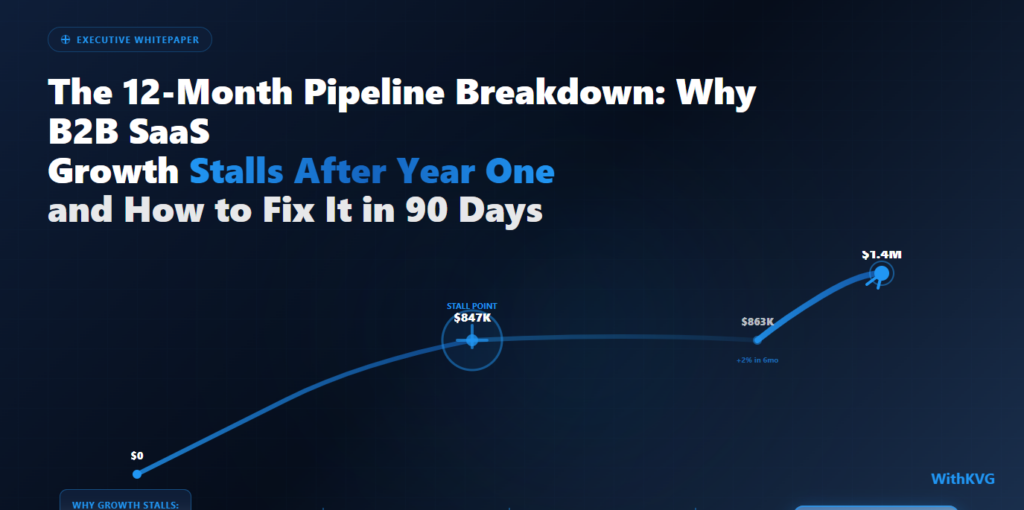
Table of Contents:
The 12-Month Pipeline Breakdown: Why Growth Stalls After Year One
Most B2B SaaS and IT companies don’t fail early.
They fail after initial traction.
In the first 6–12 months:
- Founders drive sales
- Referrals and partners bring opportunities
- Early wins create momentum
Then something shifts.
Pipeline becomes inconsistent.
Deals take longer to close.
Marketing activity increases—but revenue doesn’t follow.
This isn’t random. It’s a pattern.
At this stage, growth stops being about effort and starts being about system design.
Companies that don’t evolve beyond early traction hit a ceiling they can’t explain, and more importantly, can’t fix.
The Hidden Pattern Behind Inconsistent Pipeline and Stalled Revenue
What looks like multiple problems is usually one system failure.
You might see:
- Leads coming in, but not converting
- A “full pipeline” with weak close rates
- Revenue that fluctuates month to month
These are not separate issues.
They all point to one thing:
There is no structured, reliable way demand turns into revenue.
Without that, everything becomes reactive:
- More campaigns
- More tools
- More spend
But no real improvement.
Consistency doesn’t come from doing more.
It comes from fixing how pipeline is built and managed.
Why Most B2B SaaS Companies Misdiagnose the Problem
Most companies assume the issue is:
- Not enough leads
- Weak marketing channels
- Underperforming sales teams
So they respond by:
- Increasing ad spend
- Hiring more sales reps
- Launching new campaigns
None of this addresses the core issue.
Because the real problem is not volume.
It’s structure.
When the system behind your pipeline is broken:
- More leads = more inefficiency
- More sales reps = more inconsistency
- More spend = higher waste
Misdiagnosis leads to scaling the problem instead of fixing it.
The Five Core Failures Causing Pipeline Instability
Across B2B SaaS and IT companies, pipeline breakdown consistently comes from five core failures:
- Misleading KPIs
- Dependency on external sources (partners/referrals)
- Lack of demand generation
- Poor data and visibility
- Retention masking weak acquisition
These are not tactical issues.
They are structural failures.
Until they are addressed at the system level, growth will remain unpredictable.
Failure One: Fake KPIs That Drive Wrong Decisions
Many companies track activity not outcomes.
Metrics like:
- MQLs
- Website traffic
- Cost per lead
Create the illusion of progress.
But they don’t answer the only question that matters:
Is pipeline turning into revenue predictably?
When KPIs are disconnected from revenue:
- Teams optimize for the wrong goals
- Decisions are based on noise
- Performance looks better than it actually is
The result: confidence without control.
Failure Two: Overreliance on Partners and Referrals
Partners and referrals are valuable but dangerous when they become the foundation.
They are:
- Unpredictable
- Outside your control
- Difficult to scale
When pipeline depends on them:
- Growth becomes fragile
- Forecasting becomes unreliable
- Revenue becomes reactive
Companies often realize this too late when flow slows down and there’s nothing to replace it.
Failure Three: No Real Demand Generation System
Most companies don’t generate demand.
They capture existing demand.
That means:
- Competing for buyers already in-market
- Relying on search and inbound intent
- Fighting for the same opportunities as competitors
Without demand generation:
- Pipeline dries up when inbound slows
- Growth becomes dependent on timing, not strategy
Demand generation creates interest before the buyer is actively searching.
Without it, pipeline will always be inconsistent.
Failure Four: Disconnected and Unreliable Data
Decisions are only as good as the data behind them.
In many companies:
- CRM data is incomplete or duplicated
- Marketing and sales data don’t align
- Reporting is inconsistent or delayed
This leads to:
- Wrong assumptions
- Poor forecasting
- Missed opportunities
Instead of clarity, data creates confusion.
Failure Five: Retention Masking Acquisition Problems
High retention is often seen as a success metric.
But it can hide deeper issues:
- Weak new business generation
- Over-reliance on existing clients
- Increasing cost to maintain accounts
Revenue looks stable but growth is slowing underneath.
Without strong acquisition, retention becomes a temporary cushion—not a long-term strategy.
Why This Is Not a Marketing Problem but a Pipeline Architecture Failure
Marketing is often blamed because it’s the most visible function.
But the real issue is deeper.
Pipeline failure is a result of:
- Misaligned systems
- Broken handoffs
- Lack of structure between stages
This is not about improving campaigns.
It’s about redesigning how pipeline works—from demand to revenue.
The 90-Day Pipeline Recovery Plan Overview
Fixing pipeline doesn’t require a complete overhaul overnight.
It requires structured execution.
A focused 90-day approach allows companies to:
- Identify core issues
- Implement foundational fixes
- Create initial predictability
The goal is not perfection.
It’s control.
Month One: Stabilize the Foundation and Identify Leaks
The first step is clarity.
This includes:
- Defining the real ICP
- Identifying where deals drop off
- Cleaning essential tracking systems
At this stage, most companies discover:
- They don’t fully understand their pipeline
- Data is incomplete or misleading
- Qualification is inconsistent
Fixing these creates a stable base.
Month Two: Build a Consistent and Qualified Pipeline Flow
Once the foundation is stable, the focus shifts to flow.
This includes:
- Introducing structured demand generation
- Improving lead qualification
- Aligning marketing and sales processes
The objective:
Ensure that pipeline entering the system is relevant, qualified, and consistent.
Month Three: Create Predictability and Scale What Works
With flow established, the focus becomes optimization.
This includes:
- Tracking real performance metrics
- Identifying high-performing channels
- Eliminating underperforming efforts
At this stage, companies begin to see:
- More accurate forecasts
- More stable pipeline
- Improved conversion rates
The Metrics That Actually Matter for Pipeline and Revenue
To maintain control, companies need to shift focus to:
- Pipeline value
- Conversion rates by stage
- Sales cycle length
- Revenue per account
These metrics provide visibility into:
- What is working
- Where pipeline is breaking
- How revenue can be improved
What Your Pipeline Looks Like Before and After the Shift
Before:
- Inconsistent flow
- Low visibility
- Reactive decision-making
After:
- Structured pipeline
- Clear forecasting
- Controlled growth
The difference is not effort.
It’s system design.
What Happens If You Do Not Fix This Now
Ignoring pipeline issues leads to:
- Slower growth
- Increasing acquisition costs
- Reduced competitiveness
Over time, the gap between you and competitors widens—not because they are better, but because their system works.
How WithKVG Approaches Pipeline Transformation and Execution
WithKVG focuses on building and operating pipeline systems not running isolated campaigns.
This includes:
- Defining growth strategy
- Implementing demand generation
- Aligning sales and marketing
- Building data and reporting systems
The goal is not short-term results.
It’s long-term predictability.
Next Steps: How to Evaluate and Fix Your Pipeline
If pipeline feels inconsistent, the first step is evaluation.
This means:
- Understanding where breakdown occurs
- Identifying structural gaps
- Prioritizing fixes based on impact
From there, execution becomes focused and results become measurable.