
















Why Your Marketing KPIs Are Lying to You and How to Build a System You Can Trust
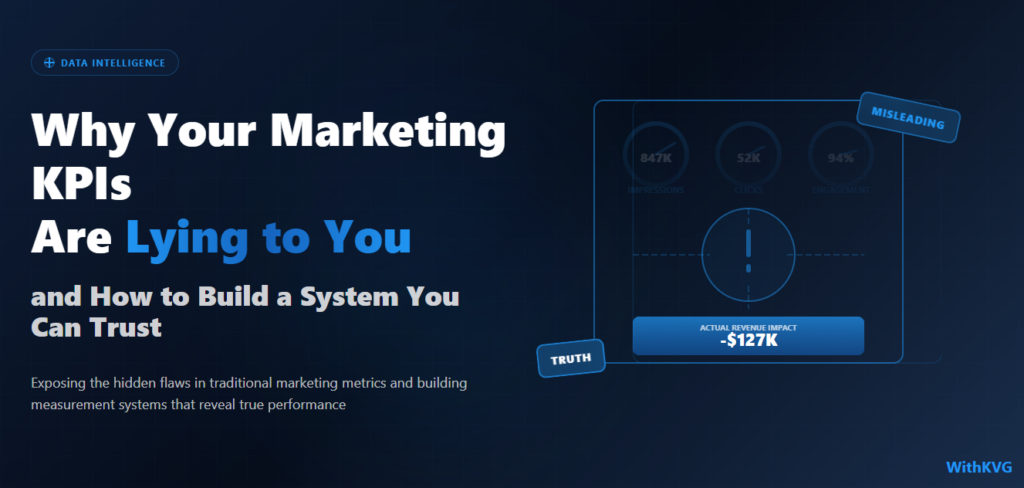
Table of Contents:
Executive Summary
Most CEOs receive marketing reports that look positive.
Traffic is growing. Leads are increasing. Campaigns are active.
But revenue does not follow.
This creates a critical problem. You are making decisions based on data that does not reflect real business impact.
This whitepaper explains why traditional marketing KPIs fail and how to build a system that connects activity directly to revenue outcomes.
For a deeper look at this disconnect, read
👉 why your pipeline does not translate into revenue
The Illusion of Good Marketing Performance
Most marketing teams report success through numbers that appear strong.
More impressions. More clicks. More leads.
But these metrics do not guarantee revenue.
They create an illusion of progress while the actual business impact remains unclear.
Many companies experience this gap between performance and results
👉 why marketing spend fails to generate ROI
Why Most Marketing KPIs Fail CEOs
The issue is not that KPIs are wrong.
The issue is that they are disconnected from outcomes.
Common problems include:
Tracking volume instead of quality
Reporting activity instead of conversion
Focusing on marketing metrics instead of sales results
This leads to a situation where marketing looks successful while revenue stagnates.
The Visibility Gap Between Marketing and Revenue
In many companies, marketing and sales operate with different definitions of success.
Marketing reports leads.
Sales reports revenue.
The connection between the two is often unclear or missing.
This creates a visibility gap where CEOs cannot accurately evaluate performance.
To understand this misalignment, read
👉 why marketing and sales do not align and how it impacts revenue
The Real Problem You Are Measuring Activity Not Impact
Most KPI systems focus on what is easy to measure, not what matters.
Examples include:
Website visits
Social engagement
Lead volume
These metrics do not show whether marketing is contributing to revenue.
A better approach focuses on:
Lead quality
Conversion rates
Pipeline contribution
For more insights on what companies miss in their tracking, read
👉 what your marketing team is not tracking that is costing you revenue
What CEOs Should Actually Track
To gain real control, CEOs need visibility into:
Pipeline generated by marketing
Conversion from lead to opportunity
Revenue influenced by campaigns
Customer acquisition cost
Time to close
These metrics connect marketing directly to business outcomes and allow for better decision making.
The KPI System That Brings Clarity and Control
A functional KPI system is not a dashboard.
It is a structured model that connects:
Strategy
Demand generation
Lead qualification
Sales conversion
Revenue tracking
At
👉 WithKVG
this is built as part of a complete growth system, not isolated reporting.
Explore how this fits into a broader system
👉 strategy and growth foundation
How a Simple Excel System Can Create Visibility
While advanced tools exist, many companies can achieve clarity using a structured Excel model.
A well designed spreadsheet can track:
Lead sources
Conversion stages
Pipeline value
Closed revenue
The key is not the tool but the structure behind it.
This approach creates a single source of truth that aligns marketing and sales.
Where Most KPI Systems Break
Even when companies track data, they fail to use it effectively.
Common breakdowns include:
Lack of consistent data input
No alignment between teams
Overcomplicated dashboards
No clear decision making process
As a result, data exists but does not drive action.
How WithKVG Builds KPI Systems That Drive Revenue
At
👉 WithKVG
we do not just define KPIs.
We build systems that connect data to revenue decisions.
This includes:
Defining the right metrics
Building tracking frameworks
Aligning marketing and sales
Creating reporting that drives action
Explore our full approach
👉 solutions
And see how this is applied in real scenarios
👉 case studies
Conclusion If You Cannot Trust Your Data You Cannot Scale
Growth requires clarity.
If your KPIs do not reflect reality, your decisions will not lead to predictable results.
Companies that scale are not the ones with more data.
They are the ones with better visibility and control.
Next Step KPI and Revenue System Diagnosis
If you want to understand where your KPI system is failing and how to fix it
This session will help identify gaps in your tracking, alignment, and revenue visibility.